
A practical, data-backed look at why marketers, freshers, and business owners are enrolling in AI powered performance marketing courses - and what you actually gain from one.
If your Google Ads dashboard now runs on Performance Max and your Meta account defaults to Advantage+, you already work inside an AI system every day - whether you were trained for it or not.
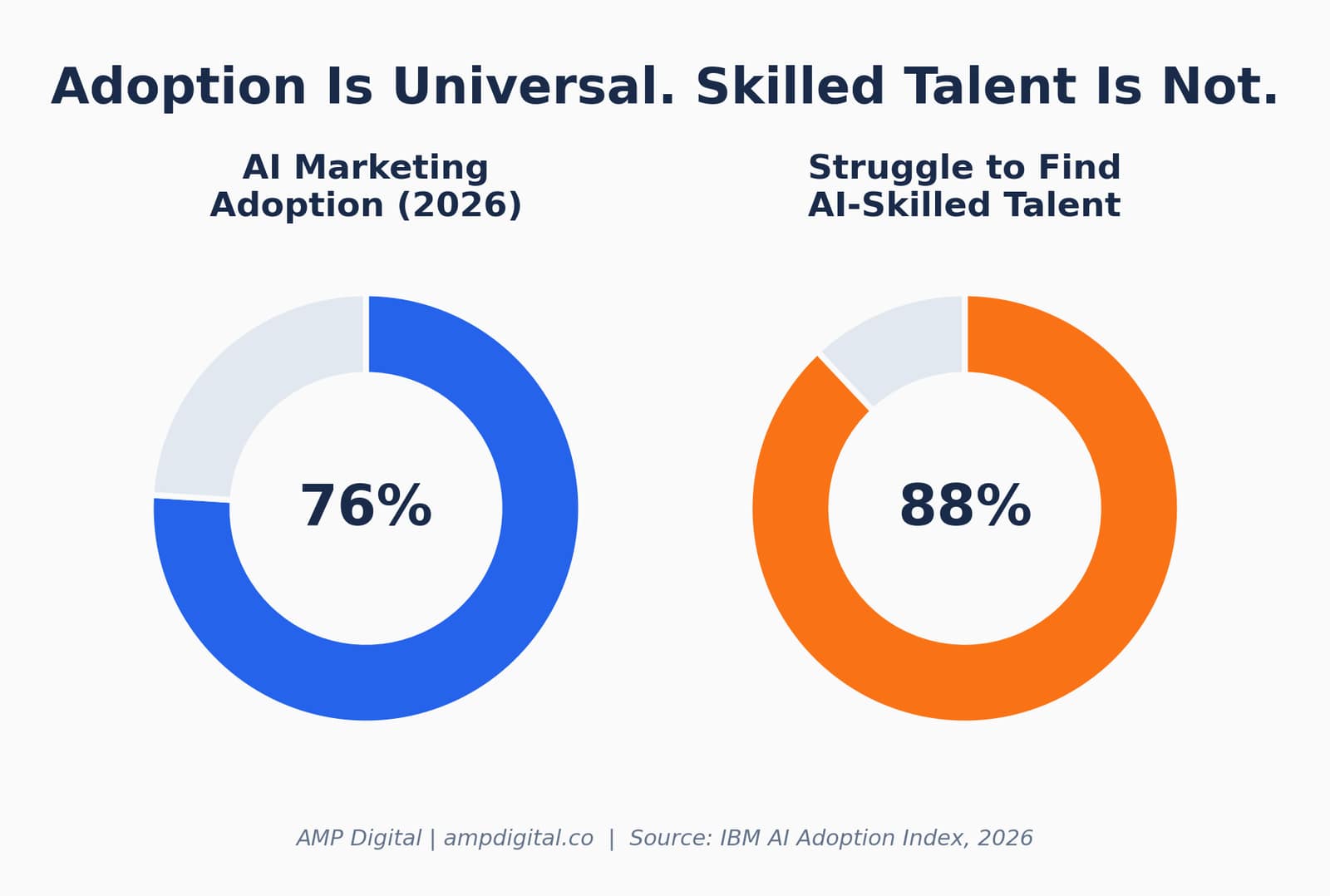
That is the uncomfortable truth behind performance marketing in 2026. The platforms have moved to AI-native bidding, targeting, and creative testing faster than most marketers have moved to AI-native skills. Worldwide AI marketing adoption has climbed to 76%, up from just 29% in 2021, yet 88% of businesses say finding people with up-to-date digital skills is still a genuine challenge. That gap between "AI is everywhere" and "we cannot find people who actually know how to run it" is exactly where an AI powered performance marketing course earns its place.
This article breaks down why marketers, freshers, and business owners are joining AI powered performance marketing courses right now: what the AI skills gap actually looks like, how much AI-driven campaigns outperform traditional ones, what a good course should teach, the mistakes untrained marketers keep making, and how this training changes a career trajectory in practical, rupee terms.
"AI literacy will shift from a value-added skill to a basic prerequisite. The differentiator will not be who uses AI, but who uses it strategically."
- Hiring Managers Report, Arfadia, 2026
What Is an AI Powered Performance Marketing Course
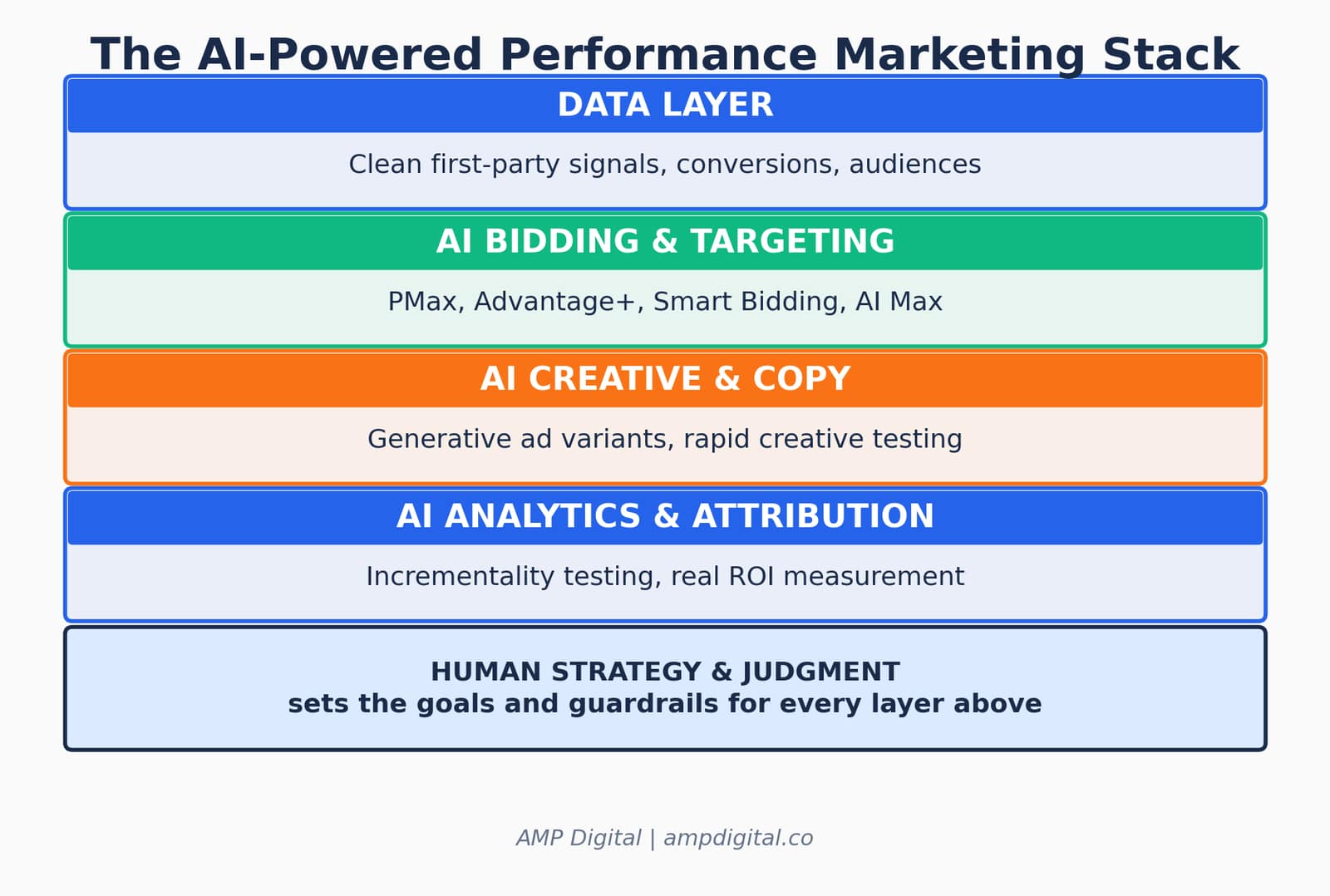
An AI powered performance marketing course is structured training that teaches marketers to plan, launch, and optimize paid campaigns using AI-native ad platforms and automation tools - not just the older, manual version of Google Ads and Meta Ads management. It combines the fundamentals of performance marketing with hands-on practice on AI bidding systems, generative ad creative, and AI-driven analytics.
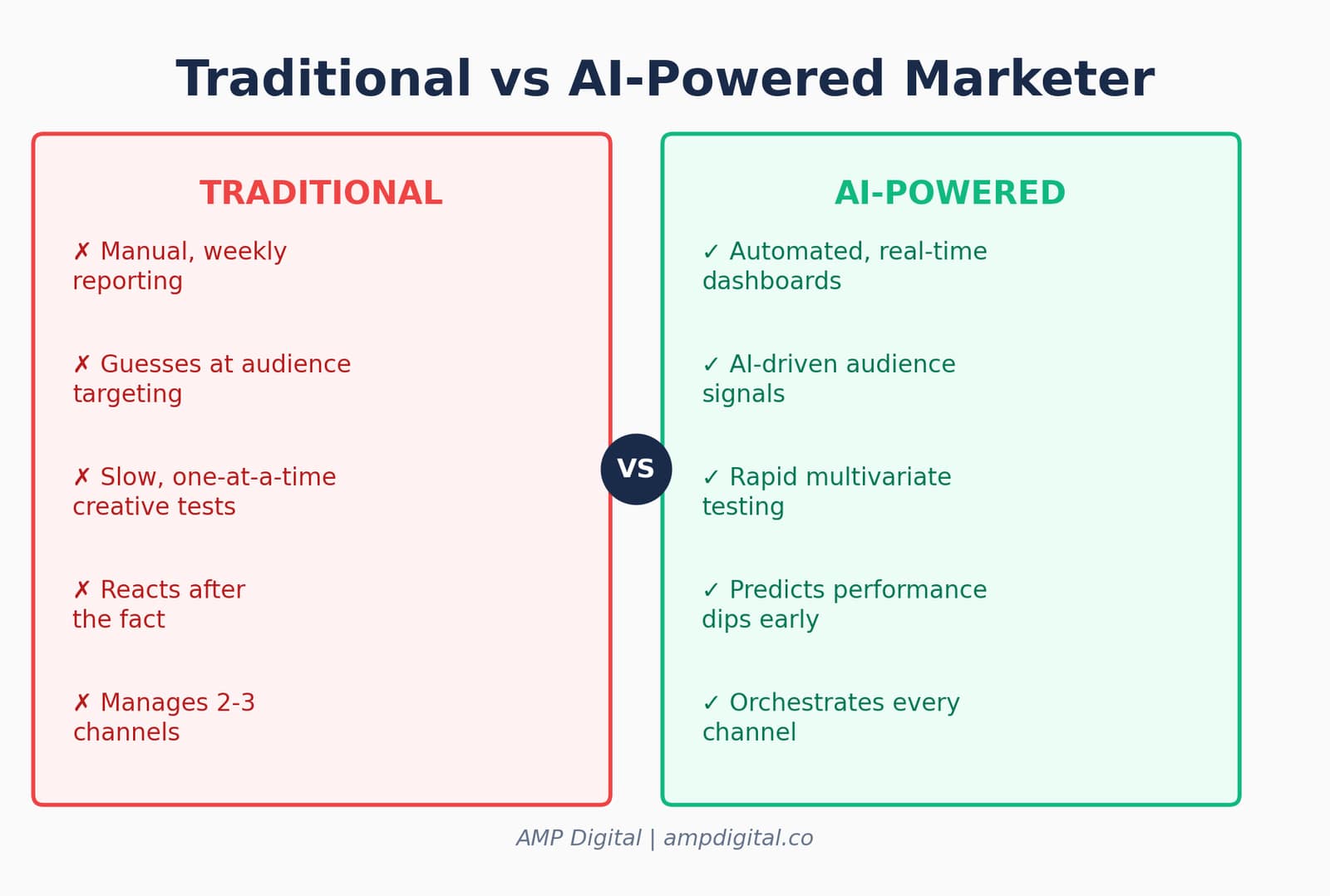
It differs from a generic digital marketing course in one key way: a generic course teaches you what a channel does, while an AI powered performance marketing course teaches you how to direct the AI systems that now run inside that channel.
Layer | What It Covers | Example Skill Taught |
Foundation | Funnels, KPIs, budgeting, audience research | Setting a target CPA before AI bidding is switched on |
AI Execution | AI ad platforms, automated bidding, generative creative | Structuring asset groups for Google Performance Max |
AI Judgment | Incrementality testing, attribution, guardrails | Running a holdout test to prove Advantage+ is adding real lift |
KEY STAT
76% worldwide AI marketing adoption rate in 2026, up from 29% in 2021 - a 162% increase in five years.
Source: IBM Global AI Adoption Index, 2026
Why an AI Powered Performance Marketing Course Matters Right Now
It matters because the performance marketing job itself has already canged, and the training most marketers received has not caught up. Manual reporting, basic content formatting, A/B test variations, and scheduled posting are being automated across the board - what remains is judgment, strategy, and the ability to direct AI systems toward a business outcome. A course closes that specific gap instead of leaving you to learn it campaign by campaign, on your own budget.
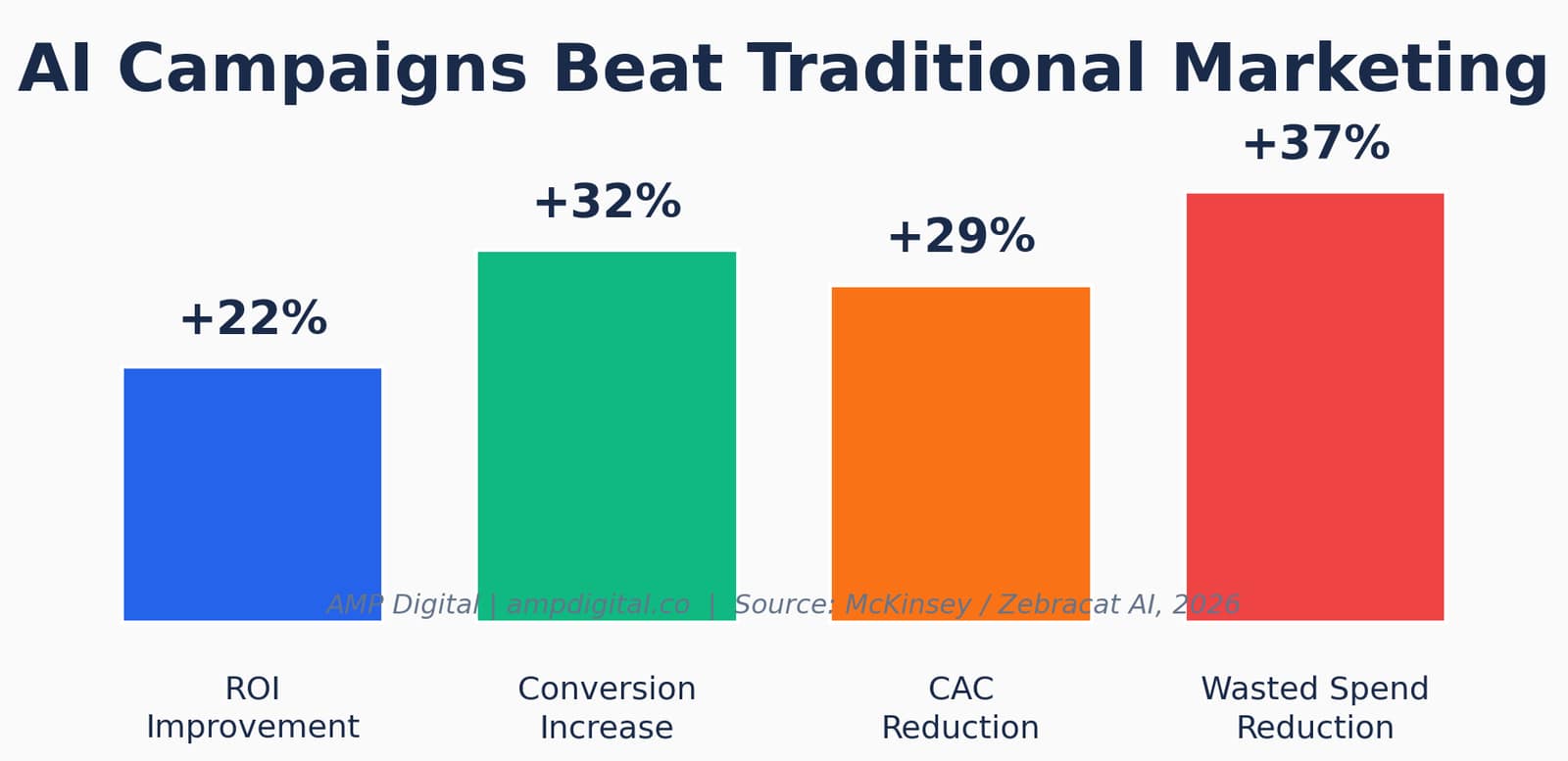
Metric | AI-Driven Campaigns | Traditional Campaigns |
ROI | +22% higher | Baseline |
Conversions | +32% more | Baseline |
Customer acquisition cost | -29% lower | Baseline |
Wasted ad spend | -37% lower | Baseline |
Source: McKinsey Digital / Zebracat AI, 2026
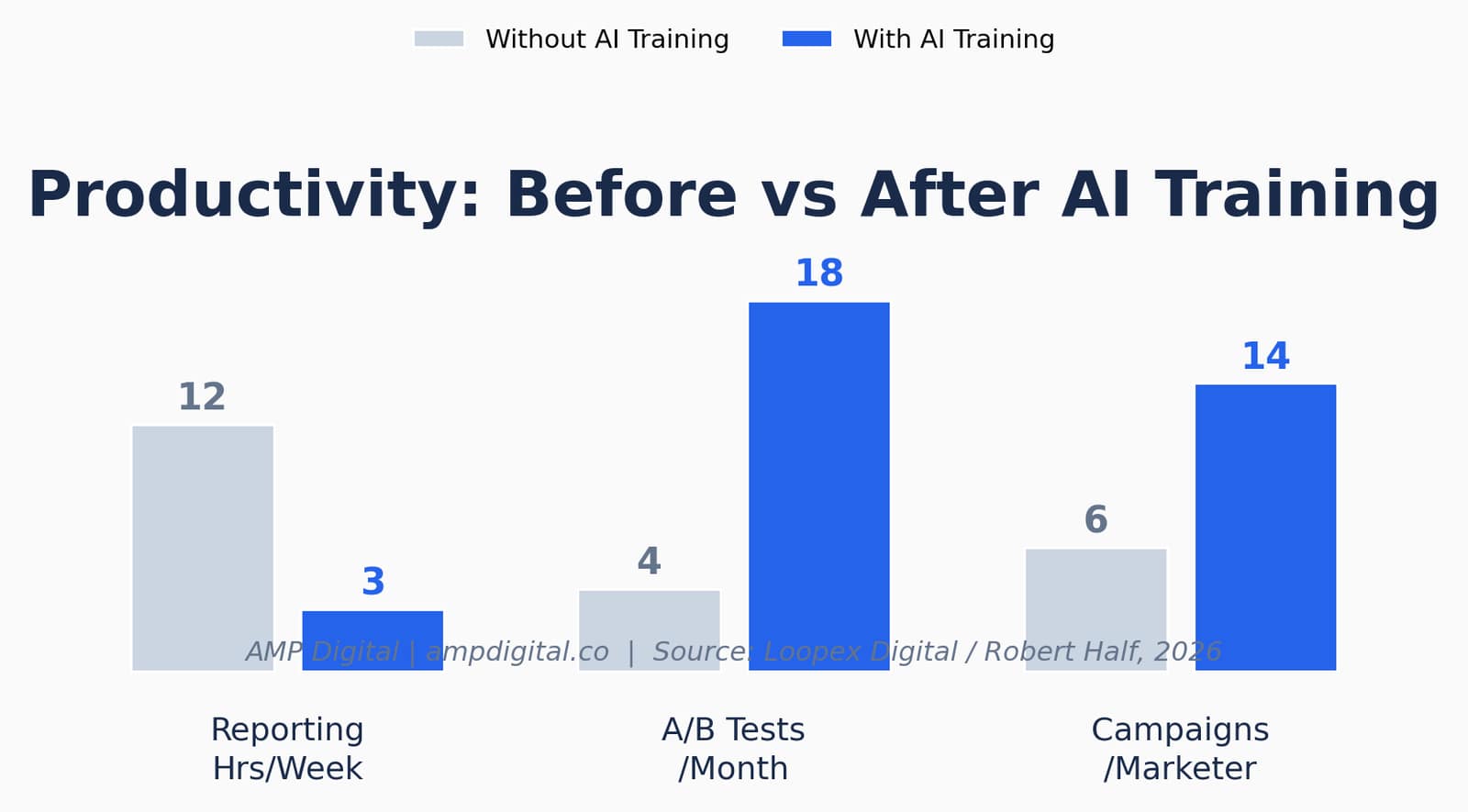
"Marketing teams using AI report 44% higher productivity, saving an average of 11 hours per week."
- Loopex Digital, AI Marketing Statistics 2026
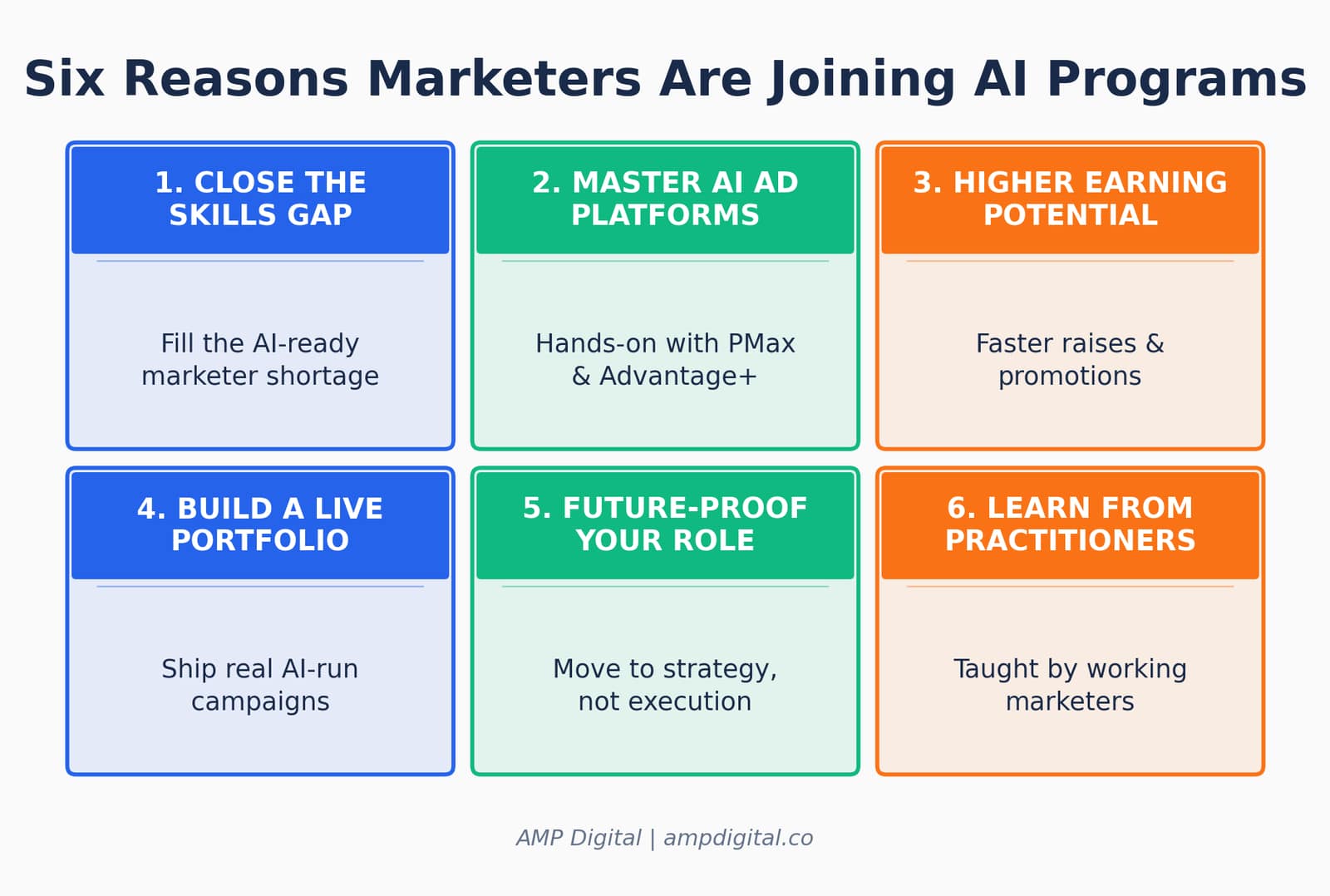
Reason 1: Close the AI Skills Gap Employers Are Desperate to Fill
The single biggest reason to join an AI powered performance marketing course is that the skills gap is real, measured, and getting worse, not better. Adoption of AI tools among marketers has become close to universal, but strategic, hands-on ability to run those tools has not kept pace.
- 88% of businesses say finding people with up-to-date digital skills is a genuine hiring challenge.
- 67% of companies struggle to find candidates with practical, real-world digital marketing skills, with the gap most acute in performance marketing and marketing automation.
- Only 23.3% of companies have AI agents fully integrated into production marketing workflows - the rest are stuck using AI in disconnected silos because nobody on the team knows how to connect it properly.
- Hiring managers now treat "used ChatGPT to write copy" and "AI literacy in a strategic context" as two entirely different skill levels, and only reward the second one.
PRO TIP
When evaluating any AI powered performance marketing course, check whether it teaches incrementality testing and attribution - not just "how to turn on" an AI ad platform. That strategic layer is exactly what separates a hireable candidate from someone who can only click Advantage+ on.
Reason 2: Learn to Run AI-Native Ad Platforms Properly
Google Performance Max and Meta Advantage+ are no longer optional add-ons - they are the default way both platforms now want campaigns run. Both promise to hand targeting and bidding decisions to AI in exchange for reach across every channel from a single interface. An AI powered performance marketing course teaches you to work with that shift instead of fighting it or, worse, blindly trusting it.
Platform | What AI Automates | What a Trained Marketer Still Controls |
Google Performance Max | Bidding, asset combination, channel mix across Search, Shopping, YouTube, Display | Asset group structure, negative keywords, first-party data feeds, budget guardrails |
Meta Advantage+ | Audience targeting, creative rotation, placement across Facebook, Instagram, Messenger | Customer budget caps, creative briefs, exclusion lists, incrementality holdouts |
AI Max for Search | Query expansion beyond exact match on Search campaigns | Brand safety controls, search term review, negative match strategy |
"AI Max, PMax 2.0, Gemini-powered Smart Bidding - these aren't shiny objects. They're the new floor. Our job is to feed it truth, guide it with goals, and guard it with guardrails - and keep a human in the loop."
- Jonathan Alonso, Founder, YellowJack Media, 2026
That last line is the entire argument for structured training in one sentence. Feeding an AI system "truth" means understanding data hygiene. Guiding it with goals means understanding business KPIs, not just platform metrics. Guarding it with guardrails means knowing how to set budget caps, negative lists, and exclusions before a campaign runs on autopilot. None of that is intuitive - it is taught.
Reason 3: Build a Portfolio That Proves Real ROI, Not Just Effort
A strong AI powered performance marketing course does not end with a certificate - it ends with a live, documented campaign you actually ran, with real numbers attached. That portfolio is what gets you past a resume screen, because hiring managers in 2026 are explicitly looking for evidence over claims.
- A capstone campaign launched on a real or simulated ad account, with before/after performance data
- An incrementality test you designed and ran yourself, showing whether an AI campaign actually created new demand
- A dashboard or report you built to track CAC, ROAS, and conversion trends without relying on a single platform's self-reported numbers
- A written case study explaining the decisions you made and why - the judgment layer that AI cannot replace
KEY STAT
95% of AI users report major cost and time savings, with productivity gains translating directly into measurable bottom-line improvements.
Source: Loopex Digital, AI Marketing Statistics 2026
The Tools and Frameworks a Good Course Should Teach
Not every AI powered performance marketing course covers the same ground. Here is a realistic comparison of what separates a surface-level course from one that builds job-ready skill.
Skill Area | Surface-Level Course | Job-Ready AI Powered Course |
AI ad platforms | Shows you where the toggle is | Teaches asset structuring, budget caps, and audience signal quality |
Creative AI tools | Generates a few sample ad variants | Teaches creative testing cadence and fatigue-signal monitoring |
Analytics | Reads platform dashboards at face value | Runs incrementality and attribution audits across platforms |
Strategy | Covers channel tactics only | Connects AI tactics back to CAC, LTV, and margin, not just clicks |
Certification | Quiz-based completion badge | Live capstone campaign with measurable outcomes |
Common Mistakes Marketers Make Without AI Training
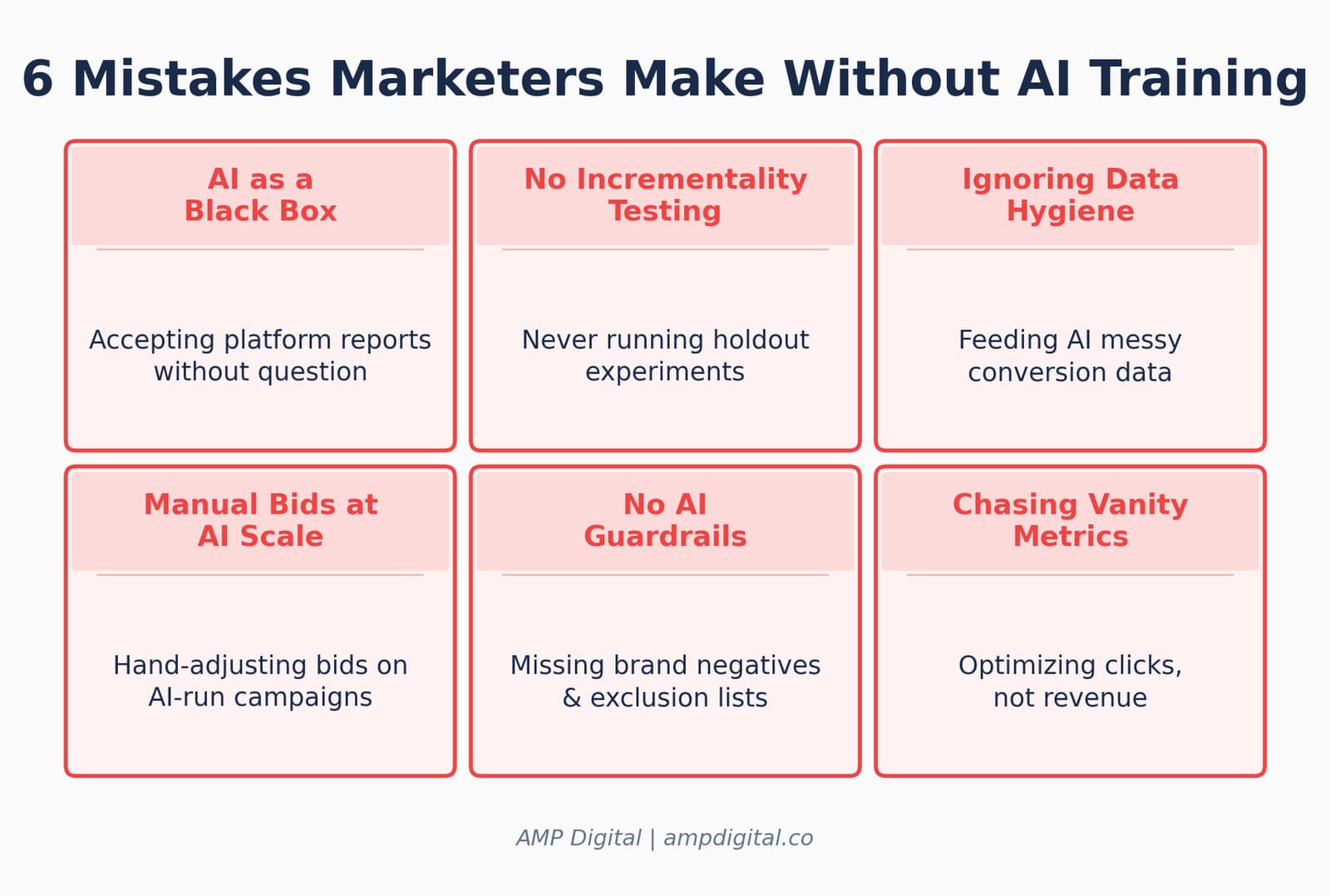
Untrained use of AI ad platforms does not usually look like failure at first - it looks like decent-enough performance with a hidden ceiling. These are the mistakes an AI powered performance marketing course is specifically designed to prevent.
WARNING
The most expensive mistake is trusting a platform's self-reported conversions without incrementality testing. A campaign can "take credit" for sales that would have happened anyway, and without a holdout test, you would never know your real ROI is lower than the dashboard claims.
Mistake | Why It Hurts Performance |
Treating AI as a black box | You cannot fix what you do not understand - inefficiency goes unnoticed for months |
No incrementality testing | AI campaigns get credit for conversions that were not actually incremental |
Ignoring data hygiene | AI bidding models trained on messy conversion data make worse decisions, not better ones |
Manual bids at AI scale | Hand-adjusting bids across dozens of AI-run campaigns wastes the time AI was meant to save |
No AI guardrails | Missing brand negatives and exclusion lists lets automation drift off-brand or off-budget |
Advanced Best Practices Taught in a Strong AI Powered Course
Beyond the basics, the marketers who get the most career value from an AI powered performance marketing course learn a specific set of habits that separate strategic AI use from simply switching automation on.
BEST PRACTICE
Run every major AI campaign alongside a small manual holdout group. Comparing the two over 2-4 weeks tells you whether the AI system is actually creating incremental revenue or simply reallocating credit for demand that already existed - the single most valuable habit taught in a rigorous course.
Other habits worth building early: auditing attribution across platforms instead of trusting one dashboard in isolation, rotating 15-25 ad creative variants weekly to stay ahead of fatigue windows that now set in within 72 hours on some platforms, and presenting results in business terms - CAC, margin, LTV - to stakeholders who do not think in platform metrics.
Real-World Examples of AI-Trained Performance Marketing in Action
These examples illustrate what the difference between trained and untrained AI usage actually looks like in live accounts.
Scenario | Approach | Result |
Fashion e-commerce paid social | Advantage+ retargeting paired with PMax prospecting for full-funnel coverage | CPA dropped 25%, but creative fatigue set in at 14 days instead of 45 - requiring faster refresh cycles |
Meta Ads account management | AI tools used to detect creative fatigue before CPM spikes | CPMs otherwise rise 30-40% once fatigue sets in; early detection protected efficiency |
Google Ads account, e-commerce brand | AI-driven PPC bid management replacing manual bidding | Ad ROI increased up to 50%, wasted ad spend reduced by up to 37% |
"We're seeing CPAs drop 25% for fashion clients but creative fatigue at 14 days instead of 45. The play: pair Advantage+ retarget with PMax prospecting to cover the full funnel."
- Jonathan Alonso, Founder, YellowJack Media, 2026
Where AI Powered Performance Marketing Is Headed Next
The direction of travel is consistent across every major research source: more automation, not less, and a widening reward for marketers who can direct that automation strategically. Machine customers - AI buying assistants that compare prices and negotiate deals through APIs - are expected to generate a meaningful share of total revenue within the next few years, and roughly 60% of transactions are projected to involve AI agents by the end of 2026.
UPDATE
Retailers observed a 694% increase in site traffic originating from generative AI tools during the late-2025 shopping season. The user base is still modest in absolute terms, but the growth curve signals where discovery is heading - and why AI-literate marketers are positioning early.
For anyone weighing whether to invest time in an AI powered performance marketing course, this trend line is the honest answer: the tasks being automated are not coming back, and the marketers who thrive will be the ones who learned to direct AI rather than compete with it.
What the Course Journey and Career Path Actually Look Like
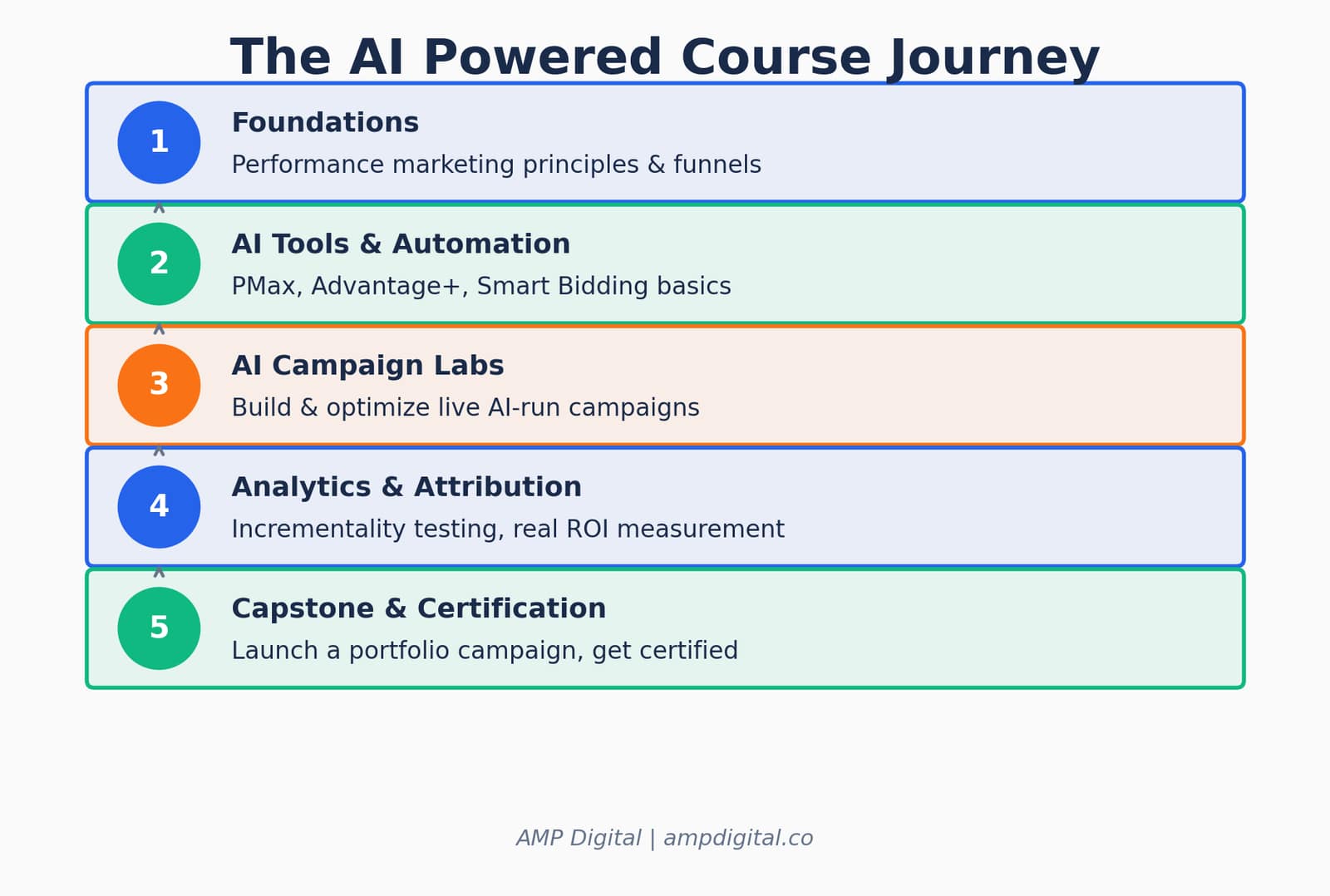
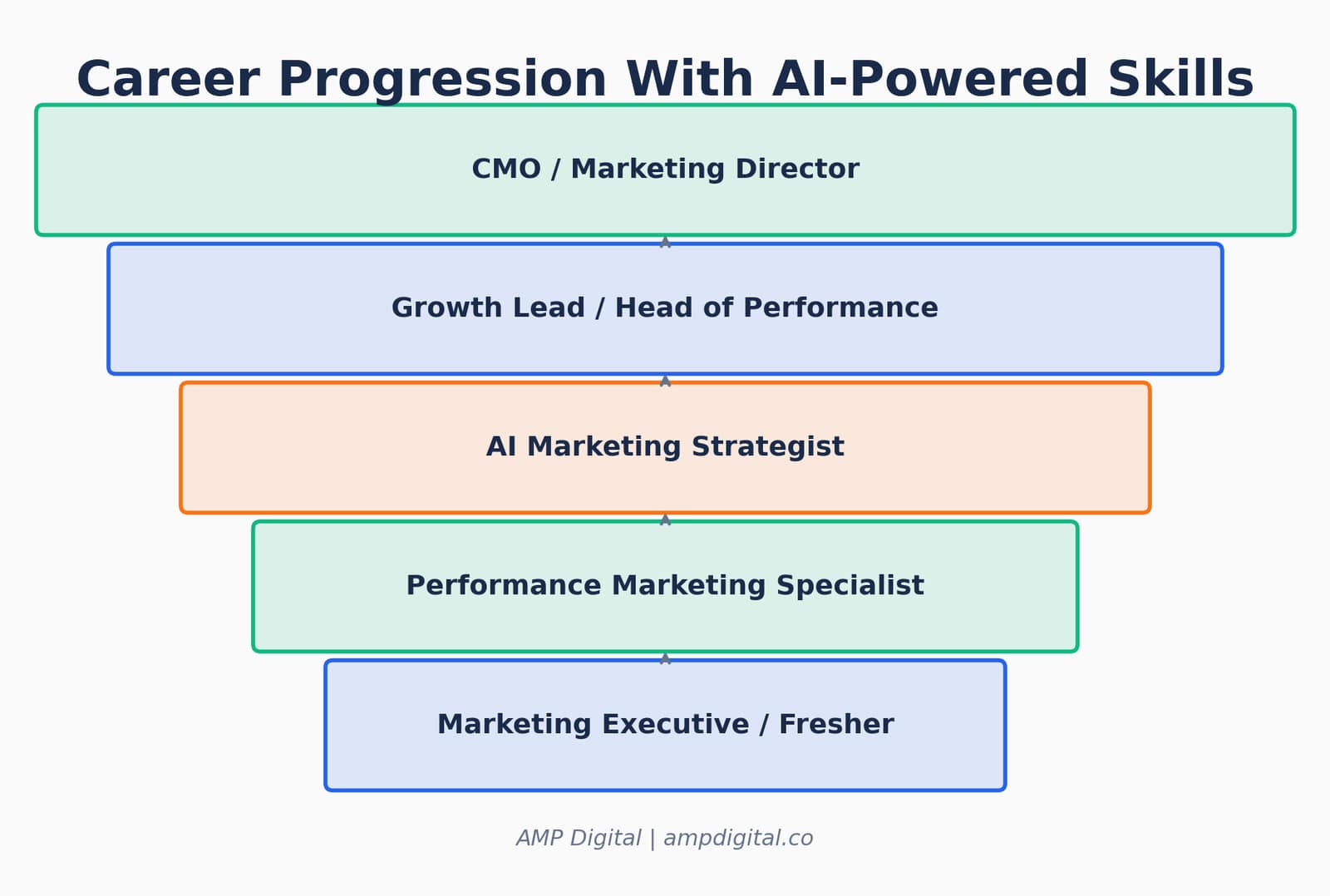
A well-structured AI powered performance marketing course typically moves through five stages, from fundamentals to a live, certifiable capstone project.
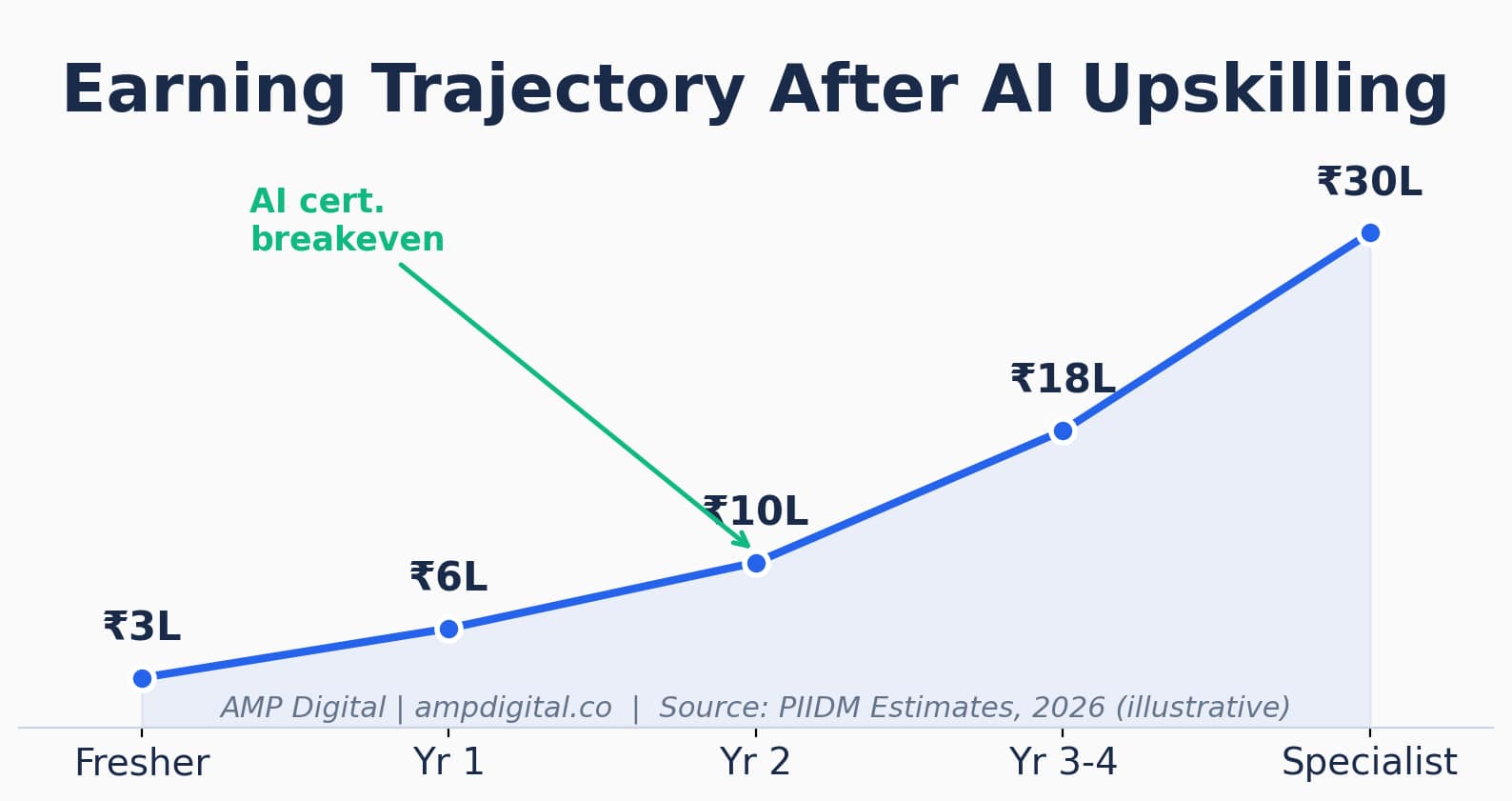
That structure maps directly onto a realistic career path - most marketers do not jump straight to "AI Marketing Strategist," they build toward it through hands-on, AI-integrated project work.
Frequently Asked Questions
Who should join an AI powered performance marketing course?
Anyone running or planning to run paid campaigns should join - freshers entering digital marketing, working marketers whose employer has already switched to Performance Max or Advantage+, freelancers competing for AI-literate clients, and business owners who want to evaluate their own agency's AI usage. Because AI ad platforms are now the default across Google and Meta, this is no longer a specialist track; it is the current baseline for the role.
Do I need a technical or coding background to take an AI powered performance marketing course?
No. Most digital marketing roles do not require coding knowledge, and a well-designed AI powered performance marketing course is built for marketers, not developers. What matters more is comfort with data - reading conversion numbers, setting KPIs, and interpreting a dashboard - since that is the layer you will use to guide AI systems.
How is an AI powered performance marketing course different from a regular digital marketing course?
A regular digital marketing course teaches channels: SEO basics, social media posting, general Google Ads setup. An AI powered performance marketing course goes a layer deeper, teaching you to structure campaigns for AI bidding systems, run incrementality tests, audit AI-driven attribution, and set guardrails so automation stays aligned with real business goals rather than platform-reported vanity metrics.
Will AI eventually replace performance marketers instead of training them?
AI is automating the mechanical parts of the job - manual reporting, basic creative variations, scheduled posting - not the strategic parts. Businesses are investing more, not less, in performance marketing, automation, and data-driven roles, and marketers who can work effectively with AI tools are seeing more opportunities and higher salaries, not fewer.
How long does it take to see career or salary impact after completing a course?
Impact varies by starting point, but many marketers see meaningful movement within the first one to two years - often coinciding with the point where a portfolio of live, AI-managed campaigns becomes strong enough to support a role change or promotion. The specific numbers depend on market, experience level, and how actively the new skills are applied.
What should I actually check before enrolling in an AI powered performance marketing course?
Confirm the course includes hands-on practice on real AI ad platforms (not just slides about them), a capstone project you can add to a portfolio, coverage of incrementality and attribution - not just campaign setup - and instructors who are practicing marketers rather than only trainers. These four checks separate a job-ready course from a surface-level one.
Is an AI powered performance marketing course worth it if my company already uses AI ad tools?
Yes, arguably more so. Using Advantage+ or Performance Max without understanding how they work is exactly the "black box" mistake that quietly caps performance. Structured training helps you audit and improve what your company is already running, rather than accepting platform defaults at face value.
Conclusion
The case for joining an AI powered performance marketing course in 2026 does not rest on hype - it rests on a gap that is visible in the data. AI adoption across marketing has reached 76%, AI-driven campaigns are outperforming traditional ones by double-digit margins on ROI and conversions, and 88% of businesses are still struggling to hire people who can run these systems strategically. That gap is the opportunity.
A good course does not just teach you which button turns Performance Max or Advantage+ on. It teaches you to feed AI systems clean data, guide them with real business goals, guard them with proper guardrails, and prove - through incrementality testing, not platform-reported numbers - that the campaigns you run are actually working. That is the skill set employers are struggling to find, and it is the skill set that keeps a performance marketing career growing instead of stalling.
SUMMARY
Before you enrol, confirm the course covers:
1. Hands-on practice on real AI ad platforms (Performance Max, Advantage+, Smart Bidding)
2. Incrementality testing and cross-platform attribution auditing
3. A live capstone campaign you can show in a portfolio
4. Instructors who are active, practicing performance marketers
5. A clear path from foundations to certification, not just tool tutorials
References
- IBM Global AI Adoption Index, 2026 - worldwide AI marketing adoption statistics.
- McKinsey Digital / Zebracat AI, 2026 - ROI, conversion, and CAC benchmarks for AI-driven campaigns.
- Loopex Digital, "AI Marketing Statistics 2026: The Complete Performance Report."
- Cesar Ritz Colleges, "Digital Marketing Certification: Is It Worth It in 2026?"
- Robert Half, "2026 Marketing Job Market: In-Demand Roles and Hiring Trends."
- Arfadia, "What Are Digital Marketing Hiring Managers Really Looking for in 2026?"
- PIIDM, "In-Demand Digital Marketing Job Roles: Trending in 2026."
- ProgBiz, "How AI Is Changing Digital Marketing Jobs in 2026."
- Profcyma, "Which Skills Employers Want Most in 2026 (Beyond a Degree)," citing Digital Marketing Institute 2025 Skills Report.
- Pixis, "Advantage+ vs. Performance Max Head-to-Head (2026)."
- YellowJack Media, "Google Ads in 2026: AI Max, Performance Max & Smart Bidding Changes."
- Stormy AI Blog, "Mastering AI Max: Optimizing Google Performance Max and Meta Advantage+ for Shopify Ads in 2026."
- Get-Ryze AI, "Top 10 AI Tools for Meta Ads Management in 2026."
- Adobe, "AI Marketing Trends" statistics compilation, 2026.
- Shopify, "34 AI in Marketing Statistics: Industry Trends in 2026."