
Search Has Quietly Changed
There was a time when ranking #1 on Google almost guaranteed traffic.
Today, that guarantee is gone.
Users increasingly get their answers directly on the search page. Google’s AI Overviews summarize information. ChatGPT provides detailed explanations instantly. Tools like Perplexity combine multiple sources into one clean answer.
The result? Many searches now end without a click.
This doesn’t mean people stopped searching. It means search engines stopped sending users away.
In this new environment, simply ranking isn’t enough. You need to be the source that AI systems choose to reference.
That shift is called Answer Engine Optimization (AEO).
What is Answer Engine Optimization?
Answer Engine Optimization is the practice of structuring and writing content so AI systems can easily understand it, extract information from it, and cite it in their responses.
Traditional SEO focuses on visibility inside search results.
AEO focuses on visibility inside answers.
That’s a major difference.
Instead of competing for blue links, you are competing to become the “source of truth” behind the AI-generated summary.
When an AI tool references your brand—even if the user doesn’t click—you build credibility. Over time, that visibility strengthens brand trust and recall.
Why Zero-Click Searches Matter
Informational queries are most affected.
If someone searches, “How do I optimize for AI search?” Google may generate a summary that already explains the steps. The user reads it and leaves. No click needed.
For businesses that relied heavily on informational blog traffic, this changes performance expectations.
Traffic might plateau or decline even if rankings remain stable.
This is where the mindset must shift:
Traffic is no longer the only metric of success.
Authority and citation visibility are becoming equally important.
How AI “Reads” Your Content
Traditional SEO was keyword-focused. You optimized for phrases and density.
AI systems operate differently.
They rely on context and entities—clear, identifiable concepts and relationships.
If you write vaguely, AI struggles to extract meaning.
If you write clearly—defining terms, explaining relationships, and structuring ideas logically—AI can easily reuse your content.
For example:
Instead of writing,
“AI is changing marketing.”
Write,
“AI-generated search summaries are reducing organic click-through rates for informational keywords.”
The second version gives the AI something concrete and specific to work with.
Clarity increases citation potential.
The Answer-First Approach
One of the biggest adjustments in AEO is structure.
Instead of building toward your point, lead with it.
Start sections with a direct answer. Then expand.
For example:
“What is Answer Engine Optimization?”
Answer it clearly in the first few lines. After that, provide explanation, examples, and deeper context.
AI systems scan for concise, extractable blocks. When your content is structured this way, you increase the chances of appearing in summaries.
This doesn’t mean writing shallow content. It means writing strategically layered content.
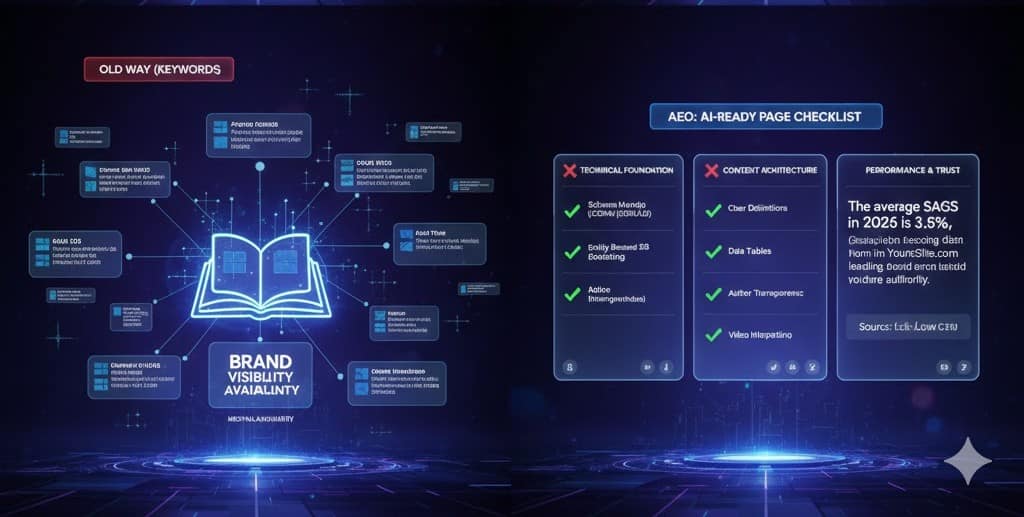
Making Your Pages AI-Ready
Strong writing alone isn’t enough. Technical clarity matters too.
Schema markup helps search engines interpret your content more accurately. FAQ schema and structured headings improve machine readability.
Clear author bios build trust. Updated publication dates signal freshness. Mobile speed ensures accessibility.
In the AI era, content must be readable by humans and interpretable by machines.
That dual optimization is what separates basic SEO from modern AEO.
SEO vs AEO: Not Replacement, But Evolution
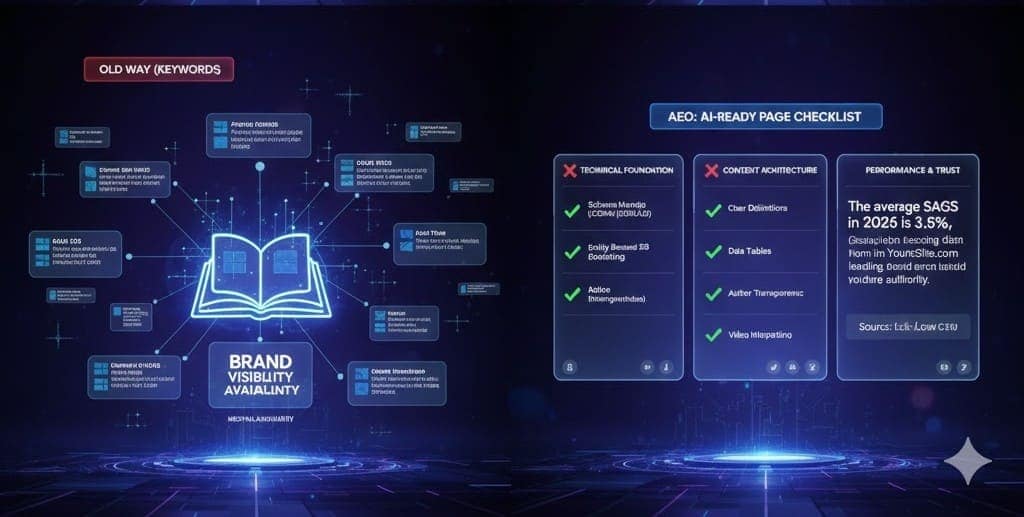
SEO is not dead. It is evolving.
You still need rankings. You still need technical optimization.
But now you also need:
• Clear answer blocks
• Entity-rich language
• Structured formatting
• Authority signals
Think of AEO as an extension of SEO, not its replacement.
If SEO helps you get indexed, AEO helps you get cited.
Becoming the Source of Truth
AI systems don’t “know” facts. They identify patterns across trusted sources.
If your brand consistently publishes structured, specific, and experience-backed insights, it becomes associated with authority.
That authority increases the likelihood of citation.
Original insights, case studies, and clear definitions are stronger signals than generic content.
In a world where AI can generate endless summaries, the real advantage is human expertise wrapped in machine-readable structure.
The Bottom Line
Search is no longer just about links. It’s about answers.
If you optimize only for clicks, you’re optimizing for yesterday’s internet.
If you optimize for clarity, authority, and structured answers, you position your brand to thrive in AI-driven discovery.
The goal is no longer just to rank.
The goal is to be referenced.
That is the core of Answer Engine Optimization.
Frequently Asked Questions (FAQ)
1. What is Answer Engine Optimization (AEO)?
Answer Engine Optimization (AEO) is the practice of structuring content so AI systems like Google AI Overviews and ChatGPT can easily extract, understand, and cite your information in their generated responses. Unlike traditional SEO, AEO focuses on becoming the source inside answers rather than just ranking in search results.
2. How is AEO different from traditional SEO?
Traditional SEO aims to rank webpages higher to drive clicks. AEO aims to increase citation visibility within AI-generated summaries. While SEO optimizes for search engine algorithms, AEO optimizes for AI systems and language models that generate direct answers.
3. What are zero-click searches?
Zero-click searches occur when users get their answer directly on the search results page without visiting an external website. AI summaries, featured snippets, and knowledge panels are major contributors to this trend.
4. How can I optimize my content for AI search engines?
To optimize for AI search, use clear question-based headings, provide concise answer blocks at the beginning of sections, implement structured data (like FAQ schema), and ensure your content demonstrates authority and expertise.
5. Why are AI citations important for brands?
AI citations build brand authority and trust. Even if users do not click your website, repeated references inside AI-generated responses increase brand recognition and influence future purchase decisions.
6. Does AEO replace SEO?
No. AEO does not replace SEO. It expands it. Brands still need traditional SEO for indexing and ranking, but they must also optimize for AI visibility and citation inclusion to remain competitive.